Home Donate New Search Gallery Reviews How-To Books Links Workshops About Contact
Nikon
85mm f/2
AI and AI-s (1977-1995)
© 2009-2012 KenRockwell.com

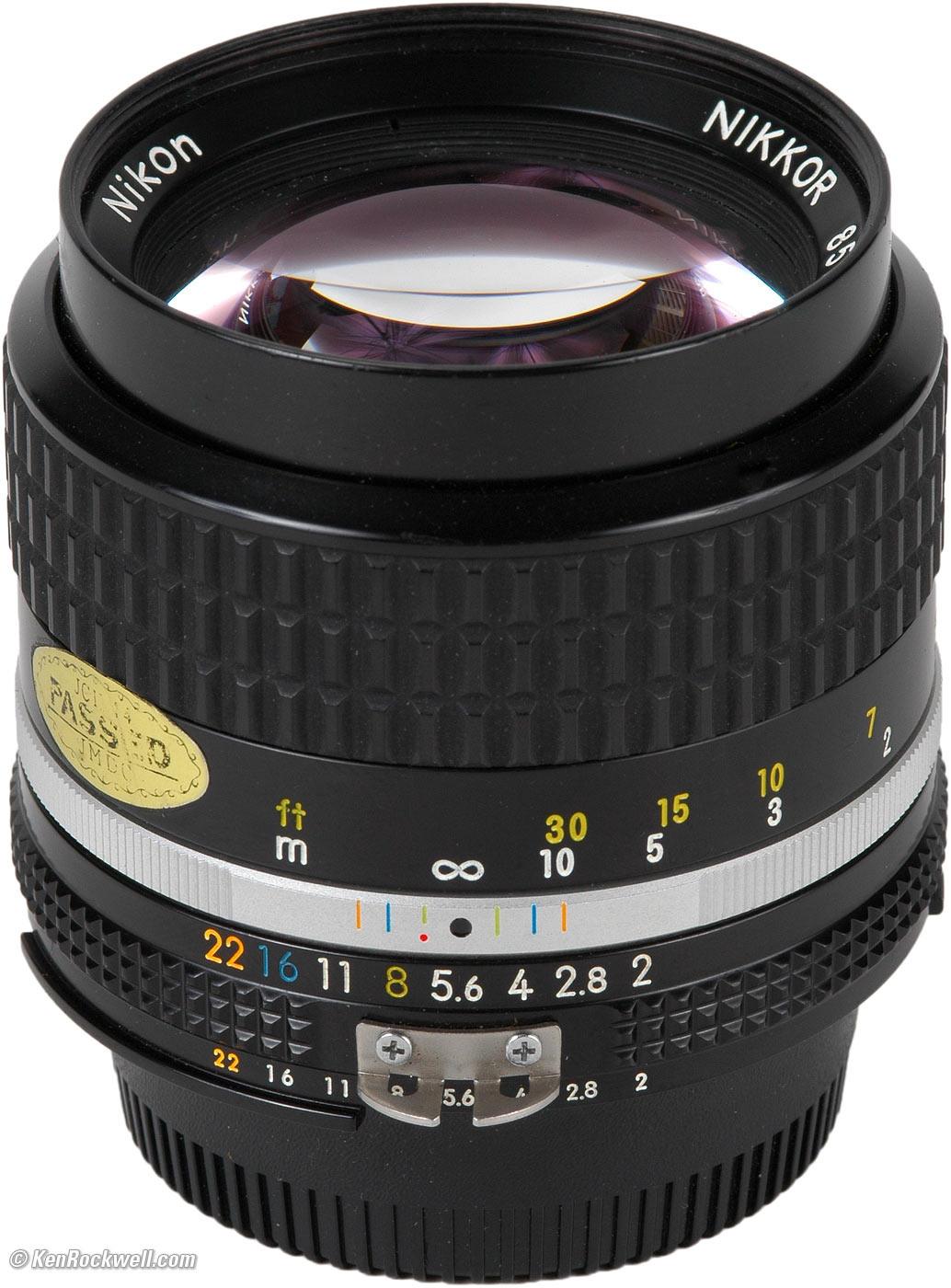
Nikon Nikkor 85mm f/2 AI-s (52mm filters, 11oz./313g, about $250 used). enlarge. This free website's biggest source of support is when you use these links, especially this link directly to them at eBay (see How to Win at eBay), and at Adorama, when you get anything, regardless of the country in which you live. Thanks! Ken.
85mm Lens Specifications Compared 23 June 2009
85mm Lens Central Sharpness Comparison 23 June 2009
85mm Lens Corner Sharpness Comparison 23 June 2009
April 2013 More Nikon Reviews Nikon Lenses All Reviews
| Optics: |  |
| Ergonomics: |  |
| Mechanics: | |
| Usefulness: | |
| Availability: |  |
| Overall: | |
Ideal Uses: Perfect for use on manual-focus FX digital and film cameras.
Not for: Fast action: focus is manual. Not for cheaper cameras that can't meter with manual lenses; use the Nikon 85mm f/1.8 AF-D instead.
Sample Images

Example photo: Door, Rancho de Taos, November 2008. enlarge. Shot with Nikon FA (chrome), Nikkor 85mm f/2 AIS, program auto, AMP metering, Fuji Velvia 50, NCPS process and scan.
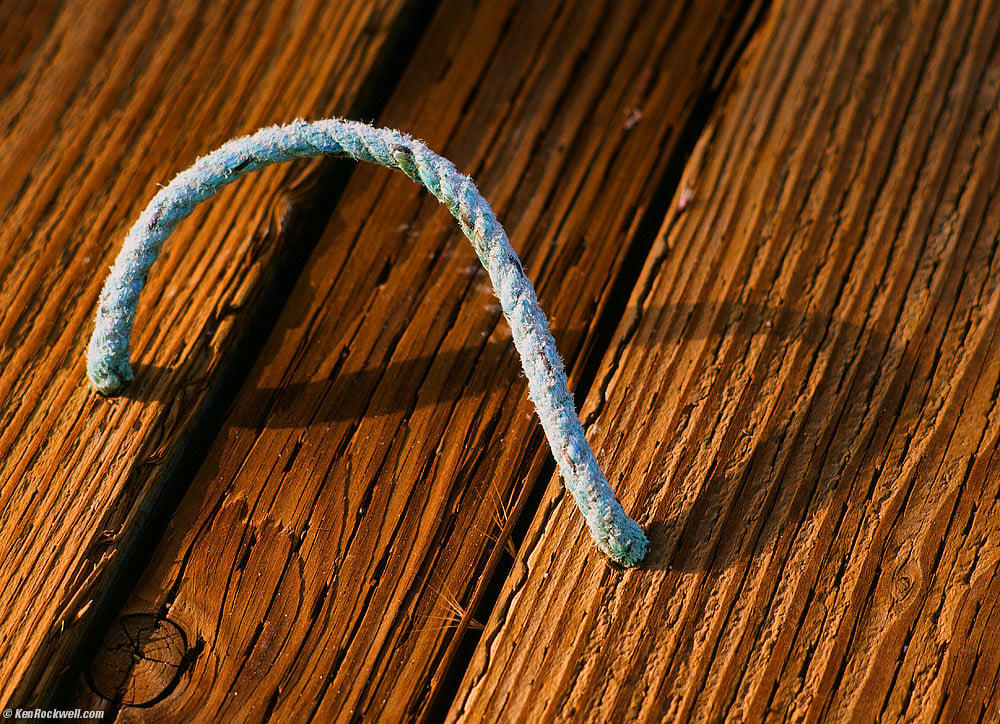
Infinity, Avila Beach, 8:20 AM, 12 April 2013. bigger. (1977 Nikon EL2, 1982 Nikon 85mm f/2 AI-s, Nikon A2 (81A) filter, Fuji Velvia 50, f/4 at 1/90 at 3 feet, process and scan at NCPS, Perfectly Clear.)
Introduction

Adorama pays top dollar for your used gear.
I use these stores. I can't vouch for ads below.
|

The Nikon 85mm f/2 is a magnificent lens. When I hit the field shooting Nikon RealRaw, this is one of the few lenses I take, and it also works great on Nikon's newest D800 wondercamera.
It's sharp, compact, fast and extremely well made. I personally prefer the 85mm focal length over other lenses; it's just the way I usually see the world.
The Nikon 85mm f/2 AI-s is compatible with every decent Nikon SLR ever made, from the original Nikon F of 1959 through today's D800, D3X, D3 , D700 and F6.
The newest upper-end digital Nikons are fully compatible, and even have this lens programmed into their firmware!
On the D800, D3X, D3, D700, D300, F6, D2 and D200, use the "Non-CPU Lens Data" menu option to input 85mm and f/2. This gives full color matrix metering and EXIF data, and finder read-out of set aperture. It works great in aperture-preferred as well as manual modes on these cameras.
It works perfectly every professional film camera (F, F2, F3, F4, F5, F6), and adds Matrix metering on the FA, F4 and F6, although it won't couple well to the cheaper digital (D80 and below) and cheaper film cameras (N80 and below).
See Nikon Lens Compatibility for details with your camera. Read down the "AI, AI-s" column.
Specifications top
It has five elements in five groups.
It has a seven-bladed diaphragm stopping down to f/22.
It focuses down to 0.85m or 2.8,' which gets you to about the same reproduction ratio as most other Nikkor manual focus lenses.
It takes 52mm filters.
It is 2.5" (64mm) around by 2.4" (61mm) long.
It weighs 11.030 oz. (312.7g). Nikon specifies 11 oz (310 g).
It takes an HS-10 hood. I've never bothered with it, and heck, you can use any ordinary rubber hood from a normal lens, too.
Performance top
Overall
This is a very good lens.
Distortion
There is no distortion.
Ghosts
It has few ghosts or flare issues on film, even though I can see a large blue blob on the opposite side of the image through the viewfinder when pointed directly at the bright sun. This is stupid; I'm surprised I didn't melt the matte plastic viewfinder screen. There is a point sized ghost on the opposite side of the image at apertures larger than f/8.
Lateral Color Fringes
I see no lateral color on Fuji Velvia. On the Nikon D800 at 36 MP, I almost can see just a hint of red-cyan lateral color in the lab, but not on actual photos.
It has a tad of spherochromatism, as expected for fast, long lens.
Sharpness
It is very sharp.
While the newer 85mm f/1.8 AF-D and 85mm f/1.8 G are slightly better optically, they are bigger and made of plastic, and when shooting on 35mm, this lens is unbeaten. Even if some other 85mm lenses are a little better, 85mm lenses are among Nikon's sharpest, and this 85/2 is among Nikon's sharpest lenses.
On the Nikon D800 (36 MP)
f/2
It's sharp, but less contrasty due to spherical aberration.
f/2.8
It's sharp and contrasty all over.
f/4
f/4 is optimum, presuming you have perfect focus.
Diffraction dulls the image from f/5.6 and smaller; this lens is that good.
On Fuji Velvia
f/2
Sharp and contrasty all over; the best performance I've seen with any lens at f/2. There is minimal falloff. At 22x there is just a little bit less sharpness wide open than at smaller apertures, and a little bit of softness in the corners compared to smaller apertures. This is outstanding performance.
f/2.8
Looks great! At 22x it's still a tiny bit less sharp than other apertures, but still outstanding.
f/4
Still outstanding and improving both center and corners.
f/5.6 - f/8
These are the optimum apertures in the center of the image.
f/8 - f/11
These are the optimum apertures for the corners of the image.
f/16 - f/22
Some random underexposure with FA camera in auto modes, hold the aperture preview button down while releasing the shutter (or starting self timer) and this goes away.
Compared top
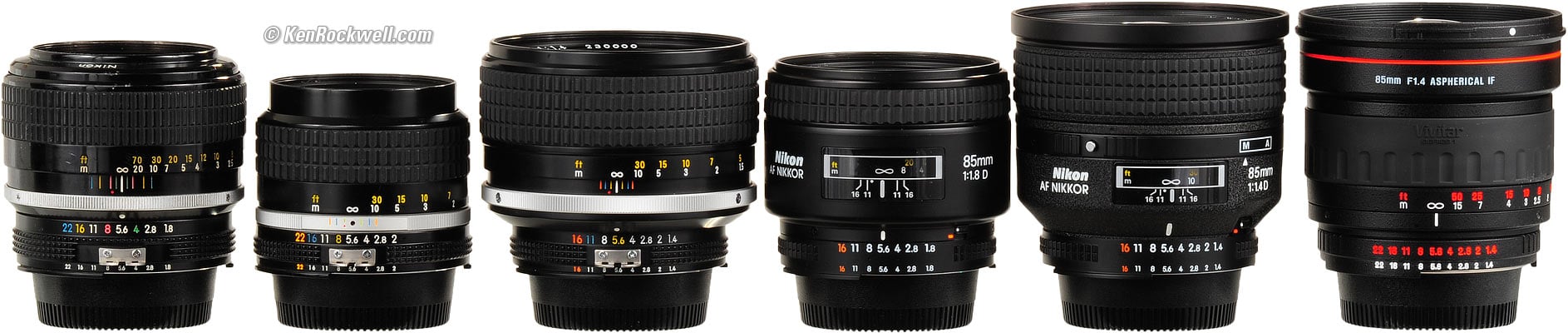
Nikon 85/1.8 K, Nikon 85/2 AI-s, Nikon 85/1.4 AI-s, Nikon 85/1.8D, Nikon 85/1.4D and Vivitar 85/1.4. enlarge (actual size at 106 DPI).
See:
NEW: 85mm Lens Specifications Compared 23 June 2009
NEW: 85mm Lens Central Sharpness Comparison 23 June 2009
NEW: 85mm Lens Corner Sharpness Comparison 23 June 2009
Recommendations top
This is the sort of lens that makes you want to throw away your zoom. It's tiny, it's twice as fast as even the very fastest of zooms, is built like a jewel, and has great optical quality on all fronts. It feels very, very solid, smooth and precise because it is. The AI-s series of manual focus lenses are the best Nikon has ever made mechanically.
Unlike other manual focus lenses, the 85mm f/2 has always held its value. I paid $250 or mine, used, in 1994, and that's been its used value ever since. The earlier AI version is the same lens but might cost you less, if you can find it.
Forget the earlier manual focus 85mm f/1.8. The 85mm f/1.8 (manual-focus) is an inferior lens, even if earlier folklore suggested otherwise.
For autofocus cameras, get the Autofocus 85mm f/1.8D. It's bigger, plasticier and takes 62mm filters, but the AF lens gives you full matrix metering and exposure mode compatibility with all AF and manual cameras, but the 85/2 AI-s will not give matrix metering on cameras other than the F4, FA, F6 and better digitals. On the other hand, the 85/2 focuses sweeter and smoother than sex itself on manual focus cameras, while the 85AF is a grindy, sloppy beast in your fingers by comparison. Either is a great choice.
Deployment
I'd keep a Nikon 52mm NC filter on it for protection on digital cameras, or when shooting color print film, or B&W film indoors.
I'd use a 52mm Hoya Super HMC 81A filter with Fuji Velvia 50 or other color slide film.
I'd use a Hoya 52mm yellow filter outdoors with B&W film.
Help me help you top
I support my growing family through this website, as crazy as it might seem.
The biggest help is when you use any of these links when you get anything, regardless of the country in which you live. It costs you nothing, and is this site's, and thus my family's, biggest source of support. These places have the best prices and service, which is why I've used them since before this website existed. I recommend them all personally.
If you find this page as helpful as a book you might have had to buy or a workshop you may have had to take, feel free to help me continue helping everyone.
If you've gotten your gear through one of my links or helped otherwise, you're family. It's great people like you who allow me to keep adding to this site full-time. Thanks!
If you haven't helped yet, please do, and consider helping me with a gift of $5.00.
As this page is copyrighted and formally registered, it is unlawful to make copies, especially in the form of printouts for personal use. If you wish to make a printout for personal use, you are granted one-time permission only if you PayPal me $5.00 per printout or part thereof. Thank you!
Thanks for reading!
Mr. & Mrs. Ken Rockwell, Ryan and Katie.
Home Donate New Search Gallery Reviews How-To Books Links Workshops About Contact